Most Wanted — His vanity gave him away
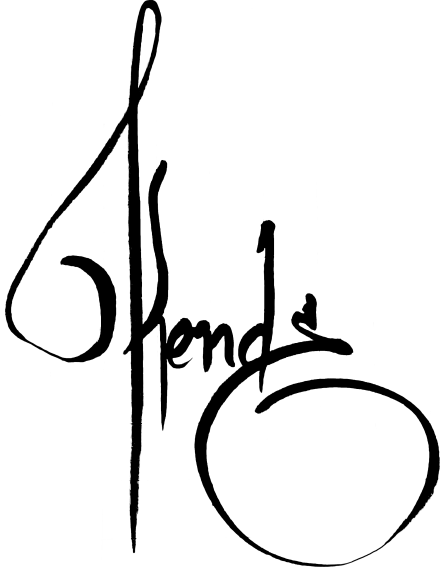
Kende is considered one of Europe’s most sought-after graffiti artists. There’s a BBC video from 2011: a journalist scours London — particularly Brick Lane — looking for him. Everywhere except in person: his signature is on walls, train carriages and shutters. In two minutes and five seconds, he even manages to ring him up. The response: a click. No interviews, thank you.
His name is Kende. The Milan Anti-Graffiti Association — which became Retake Milano in 2015 — classifies him as a “person under surveillance”. The London police have been searching for him for a long time. In the European graffiti scene of the 2000s, he is quite simply one of the most wanted graffiti artists in Europe.
A signature across half a continent
Amsterdam, Paris, Marseille, Barcelona, London, Milan. Walls, train carriages, urban spaces. A distinctive calligraphic style — rounded letters, predominantly black — which experts recognise immediately even when he changes his tag. In Milan, he leaves his mark on Via Corsico, Via Val Bogna, Via Padova, and at the Darsena. In London, he founded a record label. British intelligence investigations were lost in the files. Meanwhile, the Brescian artist’s signature began to circulate again in Italy.
The contrast that defines the work
Journalists have written about him as if he were a fugitive. The Anti-Graffiti Association has used him as a prime example of the conflict between creativity and illegality. Both have unwittingly helped to create the myth.
What the newspapers haven’t reported is the journey: thirty years of practice, a trajectory that spans 1990s European graffiti, urban calligraphy, and finally fine art. The very same letters that once appeared on train carriages are now finding their way into private collections and luxury commercial spaces. The language hasn’t changed. The context has.
Kende isn’t Europe’s most sought-after graffiti artist by chance. It’s the result of thirty years of uninterrupted practice across half the continent; he doesn’t give interviews – he didn’t back then, and he doesn’t now.